
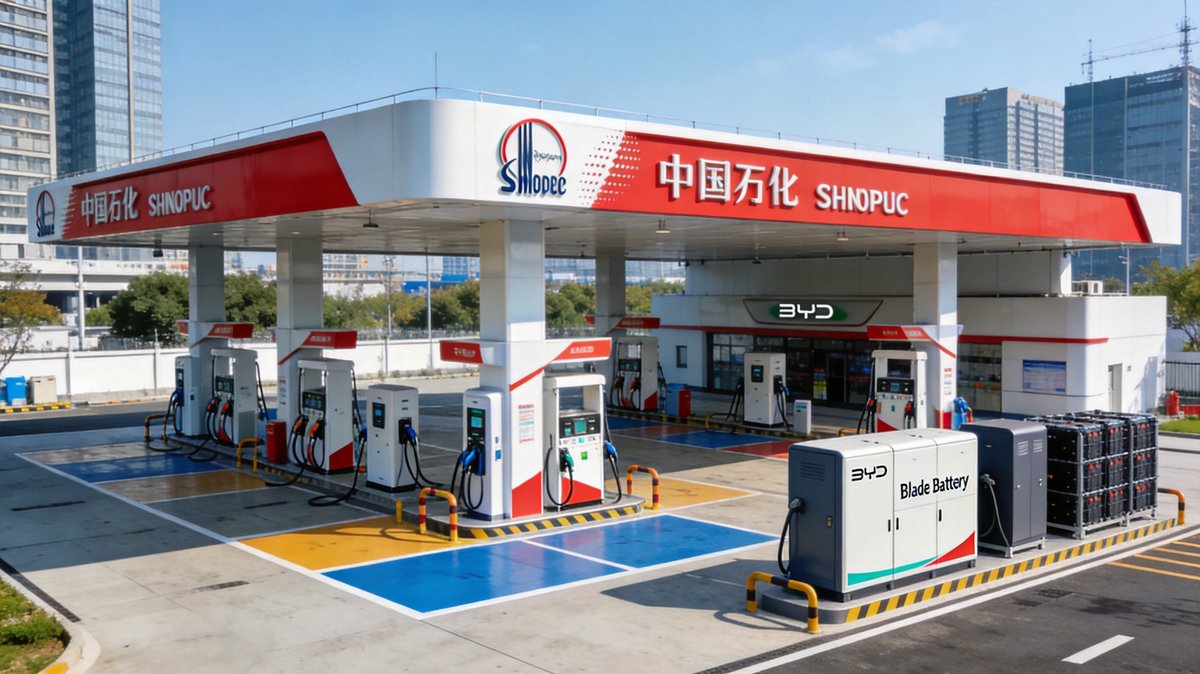
BYD and Sinopec have opened their first jointly operated Flash Charging hub in Shanghai, converting a conventional petrol station near Hongqiao Transport Hub into a 12-stall ultra-fast EV charging facility equipped with a rest area, unmanned convenience store, and health monitoring station. The station, which launched on August 8, 2026, is the first physical result of a partnership announced in June 2024 and may reshape how China deploys megawatt-level charging infrastructure.
The site is strategically positioned at one of Shanghai’s busiest transport nodes, combining an international airport, high-speed rail terminal, and three metro lines. Twelve charging stalls are arranged across six T-shaped stands, each fitted with two cables. Sinopec’s Easy Joy convenience store remains on site, now operating around the clock with digital payment only.
Battery buffers solve the grid problem
What sets BYD’s Flash Charging stations apart from conventional fast chargers is the on-site Blade LFP battery buffer system. Each charger incorporates four Blade battery packs with a combined capacity of 169 to 185 kWh. These packs charge during idle periods and discharge during peak use, allowing each unit to draw only about 100 kW from the grid while delivering up to 1,000 kW to a connected vehicle.
This architecture eliminates the need for costly substation upgrades that have slowed the rollout of ultra-fast charging in dense urban areas. With a conventional three-phase power supply, BYD can deploy megawatt charging almost anywhere. The company claims 10 to 70 percent charge in five minutes and 10 to 97 percent in nine minutes, with performance degrading by only three minutes at minus 30 degrees Celsius.
A national petrol-station network as charging backbone
The partnership’s real significance lies in scale. Sinopec operates more than 100,000 petrol stations across China, many occupying prime urban and highway real estate. Rather than acquiring land and building retail facilities from scratch, BYD can leverage an existing national footprint — a model fundamentally different from standalone charging networks. The conversion also carries symbolic weight: a state-owned oil giant repurposing fossil-fuel infrastructure for electrification signals the depth of China’s energy transition.
Sinopec has been diversifying into hydrogen, EV charging, and energy services as domestic gasoline demand peaks and declines. If the Hongqiao pilot proves successful, expect hundreds more station conversions in 2026 and 2027, creating a charging experience that few competitors can match without comparable infrastructure partnerships.
For engineering details, buffer-battery specifications and BYD’s Flash Charging roadmap, see iEVChina’s full coverage.
Edited for madeinchinanews.com
Source: CarNewsChina (August 8, 2026); BYD Weibo / Li Yunfei; Di Fen Zhi Jia (WeChat); Sinopec official.
Comments are closed.