
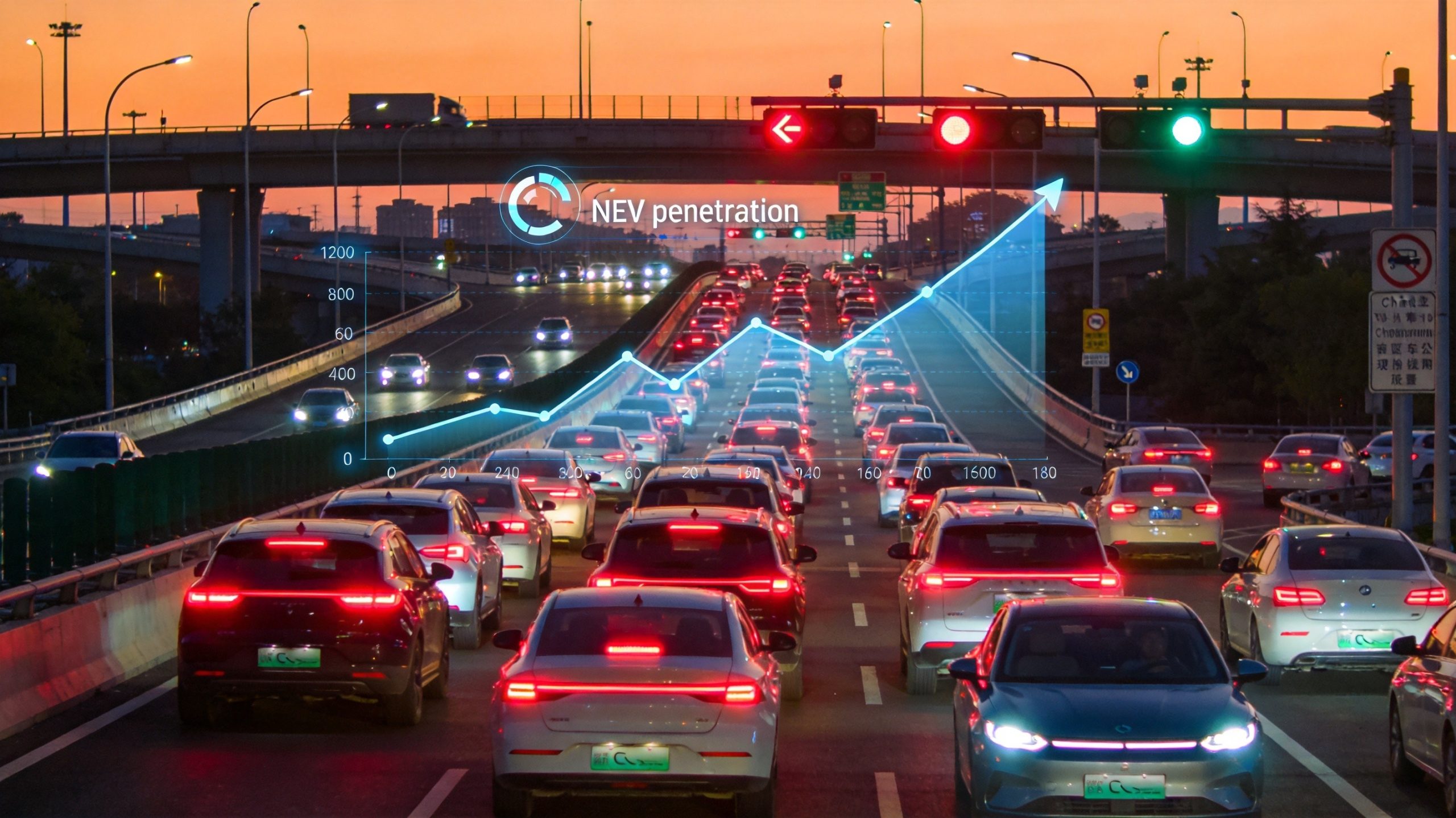
China’s new-energy vehicle retail sales held at roughly 970,000 units in July 2026 even as NEV penetration of the broader passenger-car market climbed to a record 64.4 percent, according to preliminary CPCA data. The headline 2 percent year-on-year dip in retail masks a far more significant shift: wholesale volumes jumped 23 percent to 1.47 million, exports hit fresh highs, and the combustion-engine market collapsed by 18 percent — the clearest evidence yet that electrification is accelerating, not stalling.

BYD Exports Surge While Domestic Competition Intensifies
BYD Group remained dominant with 419,211 NEV wholesale units, up 21.8 percent year on year. The standout figure was exports: 179,841 passenger vehicles shipped overseas, a 124.3 percent jump that now accounts for roughly 43 percent of BYD’s monthly volume. Yet domestic BYD sales fell about 9 percent, underscoring that even the industry leader faces brutal price competition at home.
Among startups, Leapmotor crossed 100,000 monthly deliveries for the first time (101,267 units, +102 percent YoY), while Fang Cheng Bao — BYD’s rugged off-road sub-brand — set a record at 41,213 units (+190.6 percent). Li Auto continued its slide with 30,468 units, its fourth straight monthly decline, as rivals encroach on its family-SUV stronghold. Tesla China notched its best-ever July with 93,579 wholesale units, a 37.9 percent increase driven largely by exports.
Policy Headwinds and the Export Engine
Two policy shifts are shaping the second half. Beijing’s trade-in subsidy was cut to 15,000 yuan, and from January 2027 PHEVs lose their vehicle-tax exemption unless they exceed 100 km of pure-electric range — pulling some demand forward while raising a 2027 risk. Separately, regulators proposed doubling the type-approval reliability test to 30,000 km, with 90 percent on DC fast charging, a move aimed at curbing rushed-to-market quality issues.
Exports remain the brightest spot: H1 2026 NEV exports reached 2.355 million units, up 120 percent year on year. Despite EU countervailing duties of 17–35 percent, Chinese brands are adapting through local production — BYD in Hungary, Leapmotor via Stellantis in Spain, and Chery and SAIC-MG across Southern Europe. The 70 percent NEV penetration threshold is now visible within 12 months, and the brands not positioned for that outcome risk being left behind. Read iEVChina’s full coverage for the complete brand-by-brand table and export analysis.
Source: CPCA preliminary estimates; CAAM H1 customs data; BYD July sales disclosure; Reuters.
Edited for madeinchinanews.com
Comments are closed.