
How Chinese EV Brands Captured the Gulf
In the first half of 2026, Chinese electric vehicle manufacturers achieved something that would have seemed improbable just three years ago: they became the fastest-growing foreign EV presence across the Middle East’s wealthiest markets. From Dubai’s Al Quoz showrooms to Riyadh’s fleet depots, brands like BYD, MG, Chery, and NIO are redefining what Gulf consumers expect from their cars — and from China as a manufacturing powerhouse.
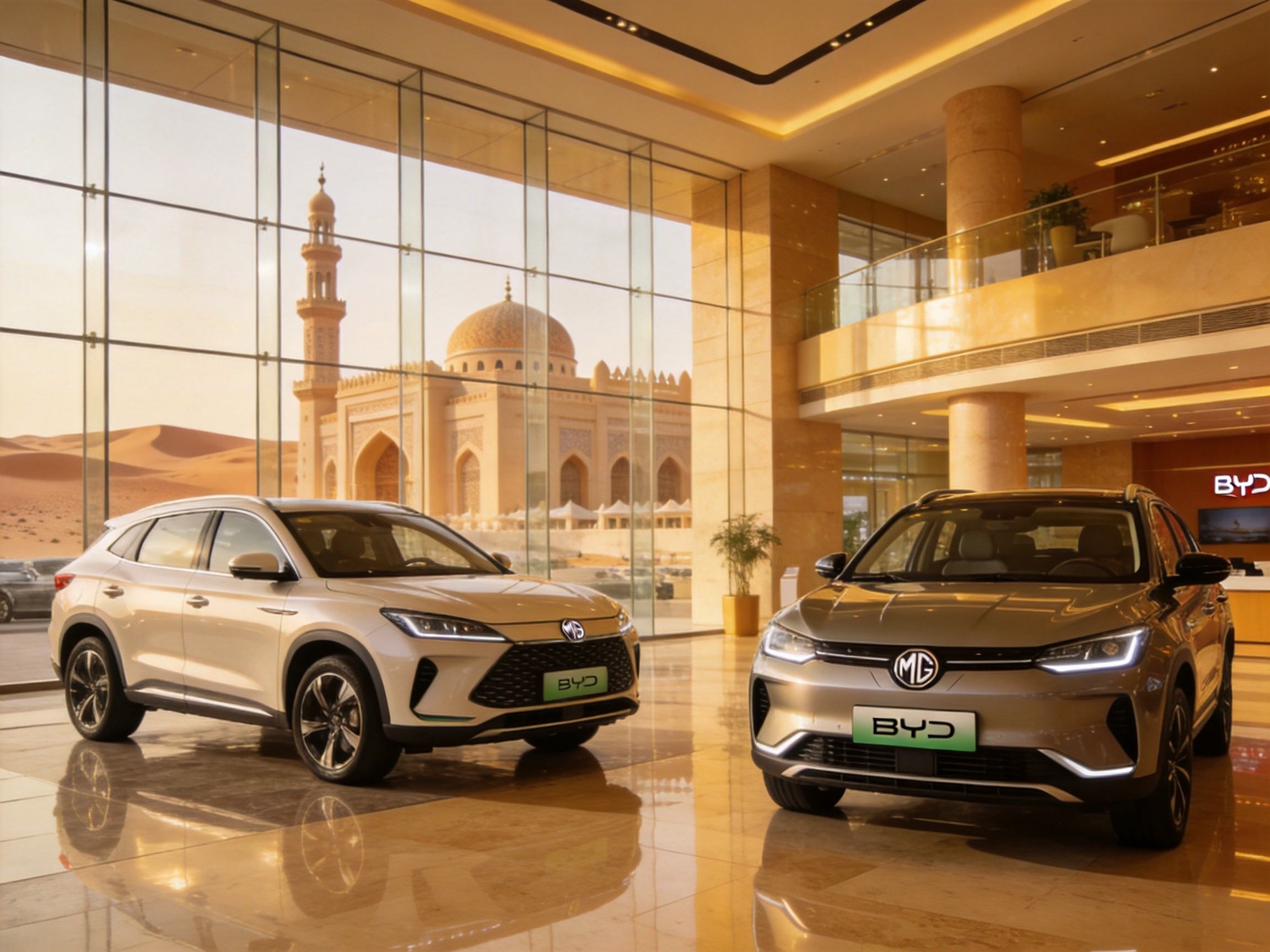
Record Numbers Across the GCC
The data tells a compelling story. BYD alone delivered over 8,000 units in the UAE during H1 2026, supported by an expanding network of seven showrooms across Dubai, Abu Dhabi, and Sharjah. MG Motor (SAIC) moved an estimated 5,000+ units, leveraging its British-brand heritage to appeal to GCC buyers. NIO opened its first UAE showroom in Dubai’s Al Quoz district in Q1 2026, introducing the ET7, EL7, and ET5 with battery-swap capability.
In Saudi Arabia — the largest GCC market — BYD signed a strategic partnership with the Public Investment Fund and began local assembly operations near Riyadh, with H1 deliveries exceeding 5,000 units. Chery, already present for over a decade through ICE vehicles, is transitioning aggressively to PHEV and BEV offerings. Even Huawei’s AITO brand entered the Saudi market in Q1 2026 through a partnership with the Abdul Latif Jameel group.
For a comprehensive analysis of these developments, iEVChina’s full coverage breaks down country-by-country registration data and market dynamics.
Strategic Drivers Behind the Surge
Several factors explain why the Middle East has become so important for Chinese EV exporters. First, unlike the EU (which imposed countervailing duties on Chinese BEVs) or the US (with tightening FEOC restrictions), GCC countries have maintained open trade policies — the UAE charges zero import duty on electric vehicles. Second, GCC consumers have among the highest per-capita GDP globally, with strong appetite for technology-forward products. The success of Huawei smartphones in the region has created a positive halo effect for Chinese technology brands entering the automotive market.
The region’s extreme heat also serves as a rigorous real-world testing ground. Summer temperatures regularly exceeding 50°C provide the ultimate stress test for battery thermal management systems. Chinese OEMs that demonstrate reliable performance in Gulf conditions gain a credibility advantage for other hot-climate markets across Southeast Asia, Africa, and Latin America.
What’s Next for Chinese EVs in the Region
Chinese NEV exports grew 45% year-on-year in H1 2026, with the Middle East accounting for an increasing share. The challenge now is building after-sales infrastructure to match sales velocity — a persistent complaint about service network maturity compared to established Japanese and Korean brands. But the trajectory is clear: the Gulf is no longer a peripheral market for Chinese automakers. It is becoming a strategic pillar of their global expansion.
Source: Industry reports + manufacturer data (July 22, 2026)
Comments are closed.