
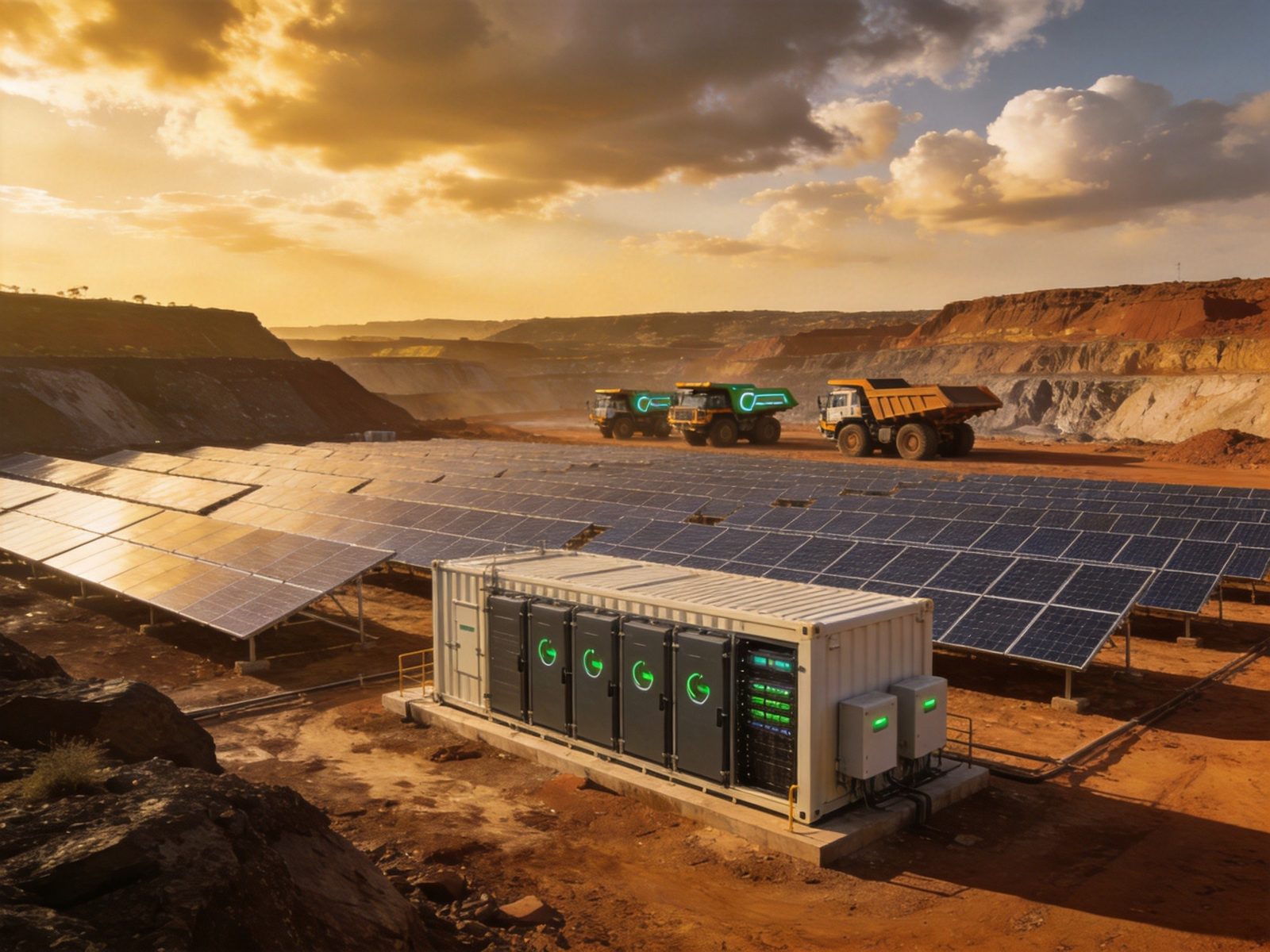
On June 29, 2026, 883 electric heavy-duty trucks were loaded at Guangzhou Port for overseas delivery — a single shipment larger than China’s entire 2025 exports of new-energy tractor units (877 vehicles). But the trucks were only the visible part of the cargo. The contract with a Zambian copper mine also bundled photovoltaic panels, container-scale battery storage, cabling, and transformers: an entire microgrid designed, built, and delivered by Chinese companies. What sailed out of Guangzhou was not a vehicle order — it was an export of the whole energy ecosystem required to make those trucks run.
One Shipment, One Year of Previous Exports
The economics are striking. SANY, the manufacturer, says the 883-truck fleet will save the Zambian mine operator roughly 150 million yuan (about $21 million) per year in fuel and maintenance — about 170,000 yuan ($23,800) per truck annually — putting payback for the combined vehicle-and-infrastructure investment at just a few years. Rival XCMG reports the same pattern: an Indonesian coal mine ordered 150 electric dump trucks, tested them, then added 100 more. China now accounts for roughly 90 percent of global electric truck sales, with a domestic market above 200,000 units a year driving down battery and component costs.
The Truck Is the Easy Part
SANY’s production line completes one electric heavy truck roughly every five minutes. What takes nine months is everything required to make it operational at a remote mining site — surveying terrain, designing the microgrid, installing solar arrays, deploying battery storage, laying cables, and configuring transformers. Many overseas customers have no grid connection strong enough to charge hundreds of EVs; as one observer put it, “a mine without electricity is just a big hole in the ground.” Chinese groups dominate every link required to fill it: electric trucks, LFP packs already below $80/kWh, the bulk of global solar-module manufacturing, and world-class power-equipment makers forged by decades of domestic grid build-out. No Western competitor offers the full package from a single industrial ecosystem.
The Moat Behind the Moat
Policy is reinforcing the model — eleven Chinese ministries have jointly folded charging stations, microgrids, insurance, and financing into the national NEV heavy-truck framework. Western incumbents such as Caterpillar and Komatsu have been slow to electrify and do not sell solar or storage; Tesla has the energy assets but no heavy mining truck. The addressable market spans tens of thousands of diesel haul trucks across Africa, Southeast Asia, Australia, and Latin America, each conversion opening a multi-year infrastructure contract rather than a one-off sale. Political risk and thin service networks cap how fast this scales — but when a single shipment eclipses an entire prior year of exports, the inflection point has arrived.
For the full SANY case study and competitive-moat analysis, see iEVChina’s full coverage.
Edited for madeinchinanews.com
Sources: SANY Group / SANY Silicon Energy (2025–2026); XCMG commercial-vehicle dispatches; 36Kr report on Chinese electric heavy-truck exports (2026); joint policy statement by 11 Chinese ministries on NEV heavy-truck promotion.
Comments are closed.