
When Xiaomi launched its first electric car in 2024, most Chinese ADAS engineers filed the brand under “cross-over consumer play.” That view no longer holds. By mid-2026 Xiaomi has moved to the front of the assisted-driving conversation — not with a new chip or a bigger LiDAR, but with a software thesis: turn the driving stack into an application on top of a general cognitive agent. The product name is Xiaomi HAD (Highway and Assisted Driving); the model behind it is XLA, Xiaomi LLM Autonomy.
Key Highlights
XLA is a latent-space cognitive large model that fuses perception, prediction, planning and control inside a single learned representation. Xiaomi disclosed 0.24-second end-to-end inference latency, well below the 0.5-second VLA-class norm, plus state-of-the-art scores on nuScenes and Waymo Open Motion. The stack is trained at foundation-model scale and fine-tuned per vehicle program — a very different pattern from bespoke perception-to-planning pipelines. Xiaomi HAD covers highway NCA, urban NCA on higher trims, and standard active-safety features across every YU7 and SU7. YU7 top trims ship Nvidia Drive AGX Thor at 700 TOPS with LiDAR, 4D imaging radar and 11 cameras.
Why It Matters
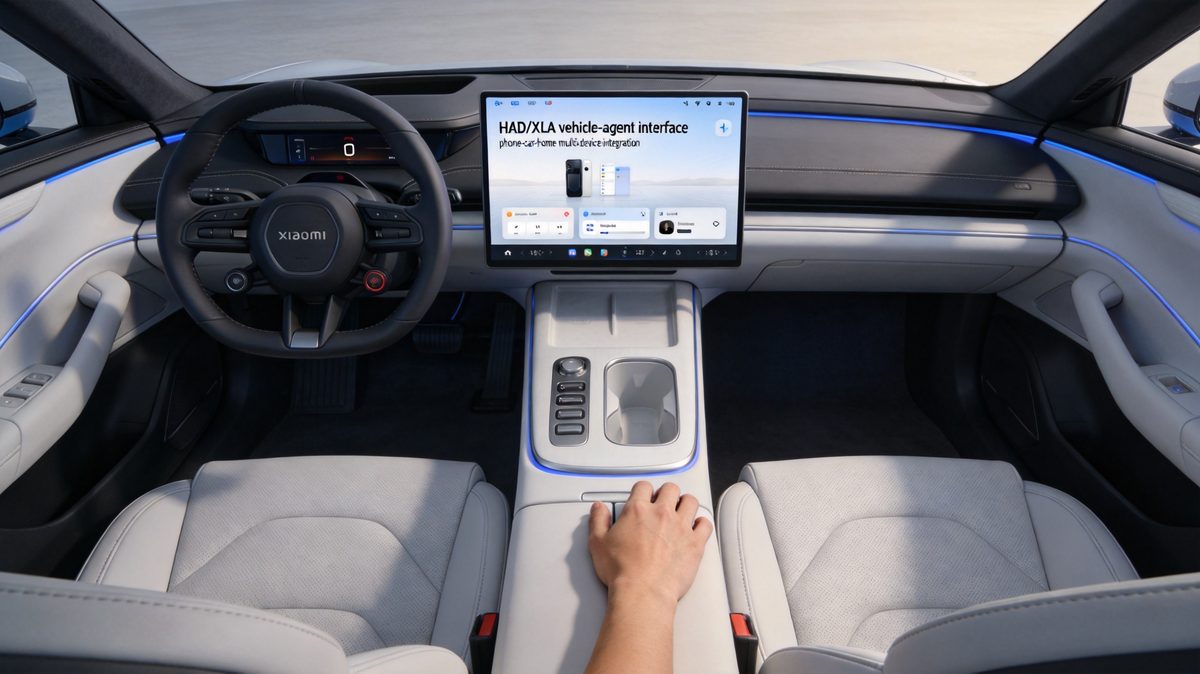
Two moves make Xiaomi different. First, the company open-sourced OneVL, a multi-modal driving foundation model with a vision-language backbone and a world-model action head. That drops the entry cost for smaller Chinese OEMs experimenting with foundation-model-scale ADAS, and seeds an ecosystem of contributors and fine-tuned checkpoints around Xiaomi’s stack — the same platform effect that anchored LLaMA in open LLM research. Second, Xiaomi is leaning into a “car agent” framing: HAD hands off to the phone at park, to Mi Home on arrival, to the smartwatch on the walk out. Backed by 640 million monthly active phones and Super Xiao Ai, that integration is nearly impossible to copy for a car-only OEM.
What Comes Next
Two gaps still constrain the story. Tesla’s global FSD fleet has logged more than 18 billion supervised kilometres versus Xiaomi’s low-single-digit-million cars, so fleet-scale training miles stay a Tesla moat until at least 2028. Xiaomi has also not filed for an L3 conditional-automation certification in China, where Huawei ADS Ultra and Mercedes Drive Pilot are already ahead. On the 2026 China ADAS competitive map, Xiaomi HAD sits close to XPeng on foundation-model depth but pulls further away thanks to the Mi ecosystem hook. For the full technical deep dive on XLA, OneVL and the YU7 sensor stack, read iEVChina’s full Xiaomi HAD and XLA coverage.
Source: Xiaomi disclosures + independent test coverage (as of July 2026)
Comments are closed.