
Sungrow Closes the Gap on CATL and BYD with 70 GWh BESS Trajectory Anchored by Masdar Abu Dhabi
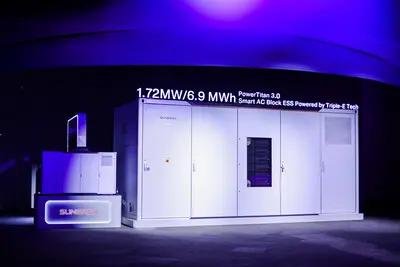
The Hefei-headquartered inverter and battery-storage specialist Sungrow Power Supply now sits within a single gigawatt-hour of CATL and BYD on annual utility-scale BESS shipments, according to industry trackers updated through mid-2026. Anchoring the trajectory is Masdar’s Abu Dhabi Round-The-Clock renewables project — currently the largest single hybrid solar-plus-storage contract globally — into which Sungrow is shipping 7.5 GWh of PowerTitan 3.0 storage hardware alongside 2.6 GW of PV inverters, making it the project’s biggest single hardware supplier.
Key Highlights
Sungrow’s official 2026 BESS shipment guidance stands at 60 to 65 GWh, with trade-press street expectations now running to 65-70 GWh based on the disclosed Q2 order book. The PowerTitan 3.0 platform itself raises the bar on three fronts: 10 MWh per 20-foot container at headline configuration, a 2,000 V DC bus voltage (versus roughly 1,500 V on the previous generation), and cell-level liquid cooling engineered for sustained 50-degree-Celsius daytime operation — a thermal envelope that Tesla Megapack and several rivals have struggled to maintain in Gulf-region deployments. The chemistry remains LFP, and the higher bus voltage trims copper and busbar costs per installed megawatt-hour.
Why It Matters
The Masdar RTC project is structured to deliver round-the-clock clean electricity to the UAE grid from a 5.2 GW solar PV array paired with 19 GWh of battery storage. Sungrow’s dual scope — both PCS containers and PV inverters into the same site — is unique among Chinese suppliers and reflects vertical-integration depth that pure-cell BESS competitors cannot match. Global utility BESS procurement is consolidating around a tight cluster of three Chinese suppliers (CATL, BYD, Sungrow), two Korean players (LG Energy Solution and Samsung SDI), and Tesla in the U.S., so Sungrow’s parallel push into both the cell side and the power-electronics side of every contract is increasingly visible in 2026 award sheets.
What’s Next
Two regulatory variables shape the H2 2026 trajectory. The European Investment Bank and European Investment Fund inverter rule, in force from May 2026, restricts cleantech project funding from using “high-risk country” inverters — putting Sungrow’s PCS scope inside a perimeter whose project-by-project applicability is still being interpreted. On the U.S. side, the storage Investment Tax Credit framework keeps standalone storage at full ITC eligibility through 2033 with phase-down through 2035; Sungrow’s local-content qualification routes will determine how much of that window the company captures. For the full PowerTitan 3.0 architecture breakdown plus the Masdar project scope, see iEVChina’s full Sungrow PowerTitan 3.0 coverage.
Source: Sungrow press, Masdar Clean Energy, prnewswire.com, energytrend.com.
Comments are closed.