
Huawei ADS 4 Pushes Urban Autonomy Below 150K RMB — 249 RMB Monthly Sub Resets China ADAS Market
Huawei’s fourth-generation Qiankun smart-driving stack is being engineered around a single commercial bet: that bundling urban autonomy into a 249 RMB monthly subscription will buy faster mass-market adoption than Tesla’s USD 99-per-month FSD Supervised pricing has in the United States. ADS 4 was formally unveiled May 16 in Shenzhen and is now moving into production deployment across more than ten partner vehicles during H2 2026.
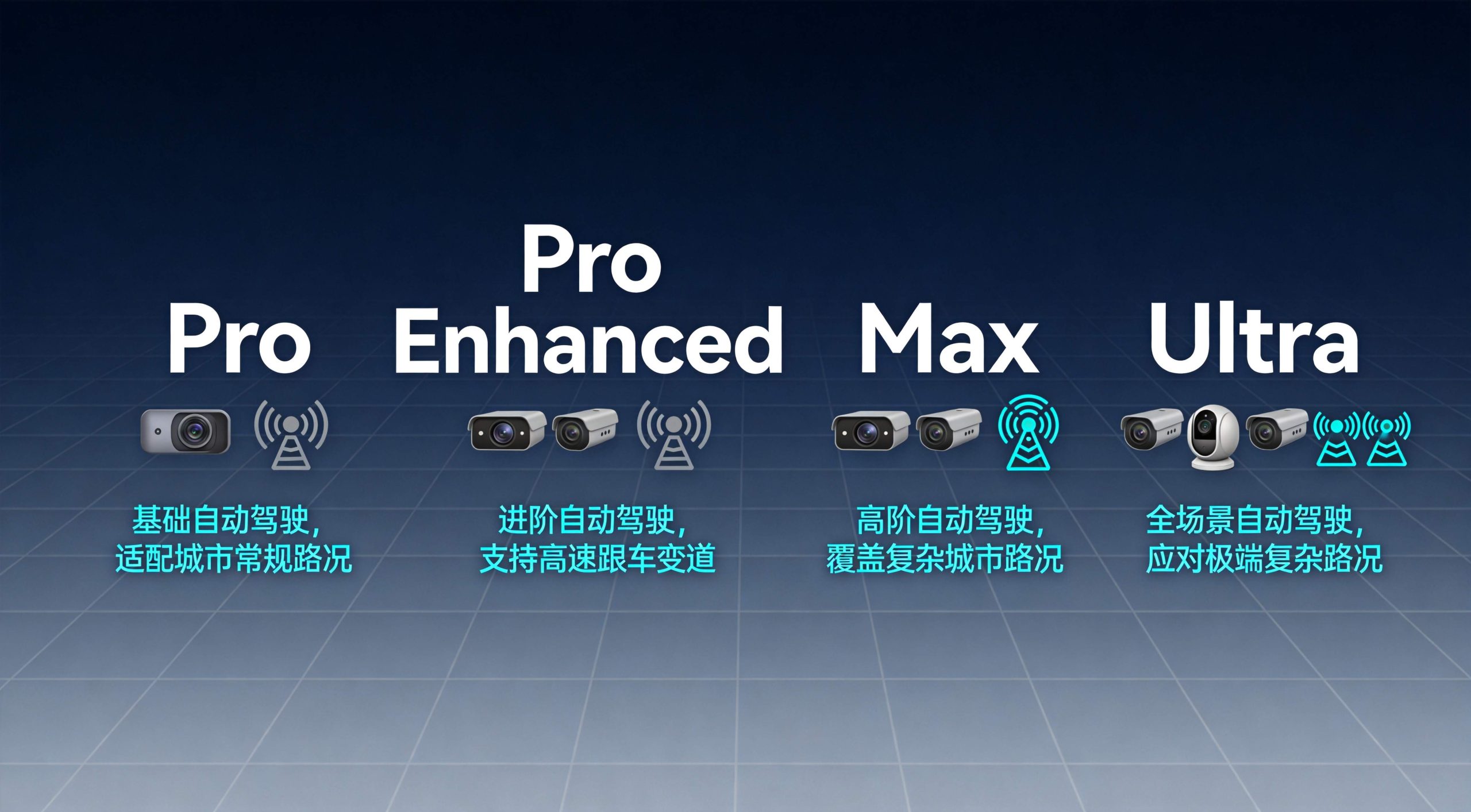
Key Highlights — Four Tiers Replace the One-Size-Fits-All ADS 3.x Bundle
The structural change in ADS 4 is the formal split into four tiers, each tied to a specific sensor / compute bundle and a different commercial model. ADS SE covers highway-only NCA, vision plus 4D radar, no LiDAR — targeting sub-100K to 150K RMB Wuling Huajing and Dongfeng eπ entry trims as standard fitment with no separate subscription. ADS Pro Enhanced adds urban NCA across 200+ Chinese cities with one 192-line solid-state LiDAR, 11 cameras and five 4D mmWave radars, targeting 150K to 300K RMB cars including the Dongfeng eπ M8, AITO M6 BEV and Voyah Zhuiguang L. ADS Max is the flagship urban autonomy tier, L3-ready in pre-mapped corridors, fitted to 300K to 600K RMB cars (AITO M8, AITO M9, Stelato G9, Luxeed R7, Mengshi M817). ADS Ultra stacks four LiDARs and the latest Huawei MDC compute board on the Maextro V680/V800 luxury sedan tier and the AITO M9 Ultra.
Why It Matters — Cloud WEWA Engine and Three New Safety Behaviours
The bigger technical shift under ADS 4 is the World Engine World Architecture (WEWA), Huawei’s cloud-based world-model engine trained on the Ascend cluster. WEWA replays real-world incident data across synthetic variants and pushes hardened policies back to the on-vehicle stack via OTA. The April 19, 2026 release added three concrete WEWA-enabled features that go beyond ADS 3.x: intelligent deceleration at accident-prone road segments, vulnerable-road-user reverse-warning when pedestrians or cyclists approach from behind during low-speed maneuvers, and automatic emergency steering as a separate-from-AEB intervention — one of the first production-shipped AES systems on a Chinese vehicle and the technical basis for Huawei’s L3 ambitions on the ADS Ultra tier.
What’s Next — 1.5 Million ADS-Equipped Cars by Year-End 2026
The H2 2026 deployment calendar so far includes the Wuling Huajing S (July, ADS SE), AITO M7 Pro Plus (OTA from June, with an ADS Max upgrade path for select trims), AITO M8 (ADS Max standard), Luxeed R7, Voyah Zhuiguang L, the BYD Leopard 8 Flash Charge (Q3 — the first BYD vehicle to ship Huawei ADS in any tier), the Dongfeng eπ M8, Mengshi M817 and the Stelato G9. Combined, the deployment wave puts Huawei’s ADS-equipped fleet on track to cross 1.5 million on-road vehicles by year-end, an installed-base lead over every competing Chinese ADAS supplier. Open questions: ADS 4 still does not advertise unsupervised highway autonomy, city-NCA performance outside the 200-city launch list remains uneven, and the Huawei MDC compute platform’s per-unit cost is still 30 to 50 percent higher than Mobileye EyeQ6 or Horizon SuperDrive HSD. For the tier-by-tier hardware breakdown, the WEWA closed-loop simulation deep-dive and the Tesla FSD vs ADS Pro Enhanced subscription economics, see iEVChina’s full Qiankun ADS 4 rollout coverage.
Source: pconline.com.cn / chinaevpulse.com / ithome.com
Comments are closed.